The Wild Bunch’s Escape from Grounding
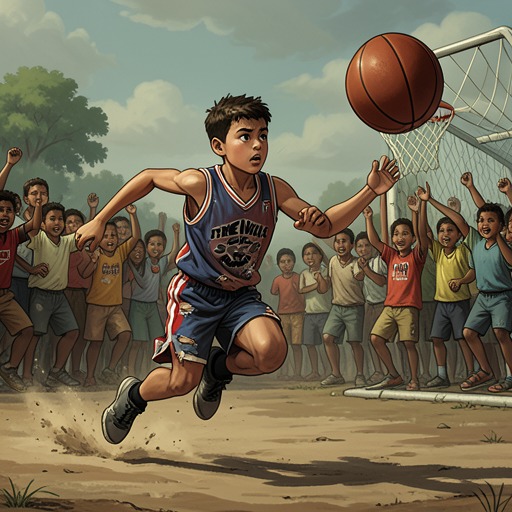
Kevin the Star StrikerThe Wild Bunch’s Escape from Grounding is the decisive act by which the Wild Bunch refuse to let adult restrictions end their soccer season. What begins as a series of individual escapes from homes on Dearborn Street, Oak Park Avenue, and elsewhere becomes a collective movement toward the soccer field. The escape carries danger, deception, poverty, family conflict, and comic ingenuity in its wake, but its larger consequence is that the boys arrive together, endure a crushing early defeat, recover through practiced teamwork, and claim victory as a group.
Causes and Background
The escape is driven by the boys’ determination to reach soccer despite being grounded or otherwise prevented from leaving home. Their desire is not presented as a casual wish to play: for the Wild Bunch, soccer is the organizing force of friendship, identity, and hope. Kevin describes the group as more than eleven friends and a dog who enjoy a game; the Wild Bunch are dangerous, wild, and bound together by their shared life on the field. That collective identity explains why punishment in one household cannot remain a private matter. Each boy must find a way out, and each escape becomes part of the same team action.
The home situations make the rebellion uneven rather than uniform. Joey’s poverty and housing instability are especially stark: his mother is out of work, they live in a van, and he cannot afford cleats or even a jacket. His mother also drinks heavily, and he sometimes fails to appear at all. These circumstances make his participation in the escape more precarious than the others’ playful disobedience. The book places this hardship beside the team’s exuberant claims of wildness, showing that the route to the soccer field is not equally available to every member.
The boys’ punishments also carry specific consequences. Alex remembers being grounded for twenty days and placed under a total soccer ban. His father’s authority is so predictable that Alex plans around it, choosing the route through the apple tree, garage, and bathroom window rather than the front door. The ban therefore produces not surrender but an alternative form of movement: Alex turns the household layout into an escape map.
The Individual Escapes
Roger’s departure begins with enthusiasm and collapses when he sees the three daughters of his mother’s friends waiting outside. His mother insists that he stay home, leaving him surrounded by pink lace and ribbon. The girls treat him as a decorative child to be cleaned and styled, while Roger rejects both their language and their control. He quietly tells them that he is not their “Roger darling” and not a guinea pig for preschool stylists, then charges through the human barrier and runs for freedom. His escape is therefore both physical and verbal: he refuses the identity imposed on him before breaking through the wall that embodies it.
Julian Fort Knox and Josh use cooperation and theatrical misdirection. Their mother refuses their pleas to go outside, so they continue making noise until she rushes from the bathroom to silence them. By then, a boom box in the hallway is broadcasting recordings of their whining. The real Julian and Josh have already fled, and their mother catches only a glimpse of them through the living-room window. The trick transforms parental surveillance into a weakness: while the recorded voices hold the house’s attention, the brothers make their actual escape down the street.
Danny’s escape is more physically precarious. He must retrieve his soccer ball from the top of the living-room shelves without breaking his mother’s expensive china. He balances on a chair standing on four unsteady towers of books, reaches the ball with his fingertips, and nearly sends two plates rolling to the floor. When the chair tips, Danny releases the ball and performs a desperate balancing act on its arm before catching the plates just as the chair settles. The scene makes the soccer ball both the object of his mission and the source of immediate danger; preserving the household’s fragile order becomes the price of getting back to the team.
Alex completes his route through the bathroom window, but not before Danny has helped him. Danny’s instructions identify the bathroom window above the garage and the old apple tree beside it, allowing Alex to dash into the bathroom after receiving the message. Danny then leaves under his mother’s disapproving gaze, shrugging and defending his intervention with the argument that Alex cannot be expected to solve the escape alone. His grin and hurried departure turn assistance into a small act of team loyalty, even as he knows he is running toward disaster.
From Escape to Confrontation
The separate fugitives gather one block from the soccer field: Danny, Julian and Josh, Alex, Tyler, and Kevin. They laugh about being grounded and banned from soccer, postponing concern about the consequences until evening. Their mood changes when they turn the final corner and collide with the danger approaching at full speed. The escape is thus not a clean victory over parental authority. It delivers the boys directly into another form of authority and threat, the force represented by Mickey the Bulldozer and the Unbeatables.
When Joey and Kyle reach the field, they find the Wild Bunch already battered and humiliated. Mickey stands before the Unbeatables, boasting that they are unbeatable after scoring five goals in seven minutes, all by himself. Behind him, Julian has a dark green-blue-violet eye, Tyler is clutching his ribcage, and Kevin is licking a badly scraped knee. The physical evidence of the confrontation makes the cost of the escape visible. Kyle and Joey sit beside the injured players, while Joey’s anger breaks through the defeated silence.
The boys’ arrival has consequences beyond simply putting more players on the field. Joey’s circumstances make his presence itself an act of persistence, while the team’s injuries threaten the collective identity that brought them there. The Wild Bunch have escaped their homes only to discover that freedom on the soccer field must still be defended. Their journey changes from evasion to resistance.
The Match as the Escape’s Consequence
The team answers the Unbeatables with its battle cry, “ONE, TWO, THREE WILD!” Standing shoulder to shoulder in a circle before scattering into play, the boys convert their escape into coordinated action. Kevin kicks off, passes to Alex, receives the ball through Tyler and Danny, and then sends it to Joey. Joey jumps over Mow-down’s legs and returns the ball before Humungous Henry can close in, but Octopus catches Kevin’s shot. The sequence establishes that the boys’ freedom is not expressed through isolated bravado; it becomes effective only when their movements connect.
The early match still belongs to the Unbeatables. Mickey scores the sixth goal after Kyle reaches the correct corner but cannot push the ball far enough to prevent it from bouncing off the inside post. The Wild Bunch then begin their recovery through shared play. Tyler draws defenders, passes to Danny, and Danny crosses toward Kevin, who resists the urge to shoot and heels the ball back after feeling Rick the Grim Reaper behind him. Alex strikes the resulting chance, sending Octopus into the goal with the ball. Kevin’s decision to pass, rather than pursue personal glory, produces the team’s first goal.
Rain changes the field and changes the balance of power. When the score reaches seven to four, the ground becomes soft and muddy, but the Wild Bunch have trained for twelve days on that kind of surface. Their preparation allows them to move through the slipping Unbeatables. Kevin scores his third goal, Danny his second, and Joey drives the ball into the corner to make the score seven-seven. Tyler controls midfield and scores from halfway, with a gust of wind carrying the ball beyond Octopus’s reach for an eighth goal. Diego then forgets his asthma and becomes the Tornado again as the Wild Bunch score number nine.
The old problem returns at the moment of apparent triumph. Kevin loses the ball because he refuses to pass, determined to score the tenth goal himself. Larry removes him and sends Roger onto the field. Kevin protests that the substitution will make the team lose, but Larry’s decision forces the Star Striker to confront the selfishness that has marked him elsewhere. Roger misses one opportunity, and Mickey narrows the gap; then Rick the Grim Reaper equalizes the match at nine-nine. The final goal will decide everything, and Kevin finally tells Larry that he will pass the ball.
The winning sequence completes the transformation begun by the escape. Kyle saves a shot from Kong while still on the ground, then rises and steers the follow-up around the post. Roger, despite another hesitation and Kevin’s warning about which foot to use, refuses to listen to fear. This time he strikes the ball and sends it into the net. The Wild Bunch win. The boys carry Roger across the field on their shoulders, while Kevin remains lying in front of the goal, stunned that Roger has become their hero. Larry then offers Kevin his hand and congratulates him, linking the victory to the lesson of the match: reaching the field was only the beginning, and remaining a team required trust, restraint, and recognition of every player’s contribution.
Significance
The escape is a collective plot of flight, but it is not merely an adventure in getting away from adults. Its episodes reveal how different kinds of authority operate: Roger rejects infantilizing control, Julian and Josh outwit surveillance, Danny risks household damage to recover a ball, and Alex turns punishment into a practical route through the house. Their methods differ because their homes and vulnerabilities differ, yet the destination unites them.
The event also exposes the contradiction at the heart of the Wild Bunch’s identity. Kevin calls the team wild and dangerous, but the decisive comeback depends on discipline learned through twelve days of muddy-field training and on passes made instead of selfish shots. The escape begins as disobedience; its consequence is a deeper form of collective responsibility. The boys do not simply evade punishment. They build, under pressure, the team they claim to be.
Finally, the episode gives victory to a group whose members carry visible wounds and private burdens. Joey arrives from poverty and family instability, Julian plays through fear and injury, Tyler protects the midfield despite clutching his ribs, Kyle saves the decisive shot, and Roger finishes the match after being treated as the least likely hero. The final celebration therefore belongs not to the fastest or loudest boy alone. It belongs to the Wild Bunch as a structure of mutual reliance, formed when every separate escape ends at the same field.